
7 Reality Checks for MusicTech + 5 VC Bets to Watch

MusicTech Insights #15 | Curated by Maciej Dulski
This issue is curated by Maciej Dulski, co-founder of MusicTech Lab, where he works with music companies and startups to build the technology behind their products.
In this edition, Maciej takes a look at some of the most interesting things happening across MusicTech right now, from the reality checks worth considering before building a product to five recent VC rounds showing where investors are putting their money.
Hi, I'm Maciej.
I run a boutique software studio built for the music industry. As engineers, we love to think we're the smartest guys in the room, obsessing over complex catalog pipelines, rights databases, and audio architecture.
The reality? The code is usually the easy part. The actual hard work is understanding where you genuinely are as a business and what you actually need from us right now.
Building tech here is rarely just a software problem. It is an operational reality check.
Most people think starting a software project means asking for a quick quote and a timeline. We don't work that way.
Before we even talk about budgets, we qualify every project against our own framework. It's not about being picky. It's about avoiding projects destined for a slow, expensive death.
Here are the 7 criteria we use to decide if we're a fit or if we'd both be wasting our time.
1. Established Music Company vs. MusicTech Startup
Established Music Company
- What we expect: Access to domain experts, clear documentation of internal processes, and patience during early security/compliance alignment.
- What we deliver: Risk-managed execution, robust API integrations, and legacy system modernization without breaking live business operations.
MusicTech Startup
- What we expect: Fast decision-making, direct access to founders, and willingness to iterate based on technical reality.
- What we deliver: Extended CTO-level leadership, scalable system architecture, and a production-ready product built for speed to market.
2. Internal Tech Team vs. No Internal Tech Team
Internal Tech Team Present
- What we expect: A dedicated tech lead on your side, established repo guidelines, and direct developer-to-developer communication.
- What we deliver: Specialized MusicTech engineering firepower, clean code handoffs, and friction-free integration with your current dev workflow.
No Internal Tech Team
- What we expect: Full clarity on the business objective and a single point of contact available for weekly (or daily) reviews.
- What we deliver: Full end-to-end technical ownership, product strategy, and complete translation of business goals into functioning software.
3. Legacy Infrastructure vs. Greenfield
Legacy Infrastructure
- What we expect: Realistic expectations regarding technical debt, legacy data cleanup, and third-party API limitations.
- What we deliver: System orchestration, data normalization, and reliable middleware that unifies your fragmented tool stack.
Greenfield
- What we expect: Alignment on core MVP features to prevent early scope bloat.
- What we deliver: Clean, modern codebase with zero technical debt, built to scale as your user base grows.
4. Single Decision Maker vs. Committee Approval
Single Decision Maker
- What we expect: Rapid feedback on architecture proposals and firm authorization to pivot when needed.
- What we deliver: Maximum development velocity, short sprints, and rapid production deployments.
Committee / Multi-Stakeholder Setup
- What we expect: A designated Project Owner authorized to consolidate internal feedback and make final calls.
- What we deliver: Structured milestone roadmaps, executive-level technical reporting, and clear scope boundary management.
5. Problem-Driven vs. Solution-Driven
Problem-Driven (“Our royalty calculations take 3 weeks”)
- What we expect: Openness to technical discovery and willingness to solve the root cause rather than the surface symptom.
- What we deliver: Deep workflow analysis, automated backend processing pipelines, and scalable architectural solutions.
Solution-Driven (“Build us this exact dashboard”)
- What we expect: Validated user research or business rationale supporting the pre-defined specification.
- What we deliver: Precise execution against spec, optimized UI/UX engineering, and performance auditing.
6. Data-Rich vs. Data-Poor
Data-Rich (Catalogs, Rights, Metadata)
- What we expect: Access to sample data sets early in the discovery phase and clear rules on data governance.
- What we deliver: High-throughput ingestion pipelines, metadata cleaning, and automated reconciliation systems.
Data-Poor (New Concepts)
- What we expect: Focus on early user acquisition rather than prematurely optimizing for hypothetical millions of rows.
- What we deliver: Lean data models, fast API responses, and cost-effective cloud infrastructure ready to scale on demand.
7. One-Off Build vs. Long-Term Tech Partner
One-Off Project
- What we expect: Frozen project scope, strict acceptance criteria, and an internal plan for post-launch maintenance.
- What we deliver: On-time milestone delivery, comprehensive technical documentation, and structured codebase handoff.
Long-Term Tech Partnership
- What we expect: Ongoing strategic alignment, open roadmap discussions, and collaborative prioritization.
- What we deliver: Continuous architectural optimization, proactive technical advisory, and a dedicated team that knows your domain inside out.
Knowing where you stand across these 7 dimensions is what makes a technical partnership succeed from day one.
And while we're talking about what it takes to build in MusicTech, it's also worth looking at where the money is going. Here are 5 recent VC bets that caught my attention.
Former Spotify innovation lead raises $5.5M for a new kind of music app (September 2026)
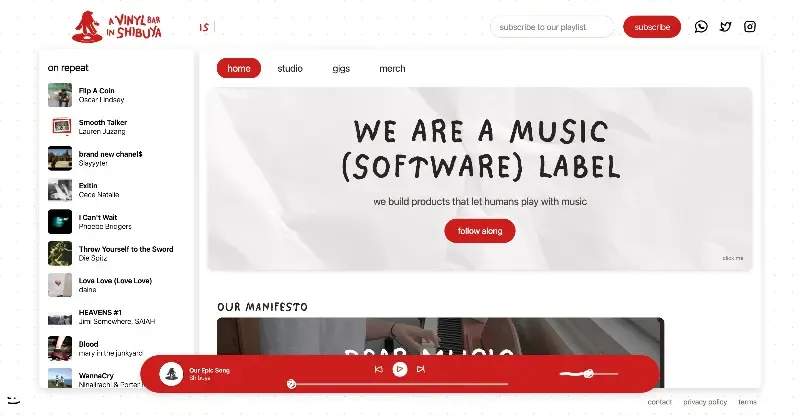
MÁSHAN M ZONOOZY, former Head of Innovation at Spotify, has raised $5.5M in pre-seed funding for a vinyl bar in Shibuya, a startup building playful music apps that let users interact with, remix, and manipulate music rather than simply consume it. The round includes Mantis Venture Capital, SV Angel, BoxGroup, Quiet Capital, and several other investors, with former Spotify executive Dawn Ostroff joining as an advisor.
What makes the bet interesting is the product thesis: rather than building yet another AI music generator, the company is exploring participation and interaction as the next layer of the music experience — releasing small experimental products as "singles" while working toward a larger consumer music app.
Soundtrap raises €3.6M at a €41.5M valuation (September 2026)
Soundtrap, the online music and podcast studio, has raised around €3.6M at a €41.5M valuation, with Industrifonden leading the round. The interesting part? Industrifonden was already a shareholder before Spotify acquired Soundtrap in 2017.
Even more interesting: Soundtrap reportedly made around €1.5M in operating profit in 2025. So this isn't exactly a startup burning cash to chase growth. As CEO Per Emanuelsson puts it, they're now entering a "new investment phase". I like this one.
Fish Audio raises $52M in seed funding after just one year (July 2026)
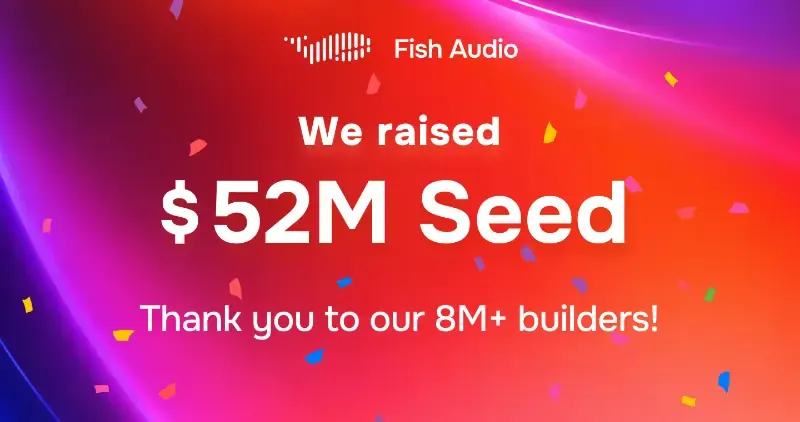
Fish Audio has raised $52M in seed funding, just one year after starting as a hobby project on a single RTX 4090. In that year, the company says it reached $21M in ARR, 8M+ users and a team of 22 people.
The obvious comparison is ElevenLabs. Fish Audio is going after the same voice AI market, but its pitch is heavily focused on expressiveness and natural delivery, not just getting the words right. $52M at this stage is a pretty loud signal that investors see voice AI becoming a much bigger layer of the tech stack.
Tickets for Good raises €4.5M to take surplus tickets global (September 2026)
UK startup Tickets for Good has raised €4.5M to expand internationally. The platform connects surplus event tickets with NHS workers, teachers, charity staff and others who might otherwise struggle to afford live events.
The numbers are already pretty serious: 750,000 verified members and 1.25M tickets distributed. Robbie Williams is also an ambassador.
I like this one because it's a pretty clear win-win: venues fill empty seats, fans get access to events, and the platform gets a scalable business around it. Simple idea, surprisingly big opportunity.
Quantizr raises $5M for AI-powered live music finance (August 2026)
Quantizr has raised $5M in seed funding to build AI tools for the financial and operational side of live music. It pulls data from offers, contracts, budgets, expenses and settlement statements, then turns that mess into something teams can actually analyse.
This is the kind of MusicTech I find particularly interesting. It's not trying to make another AI musician. It's taking one of the least glamorous parts of the industry and making it less painful. With clients including C3 Management, Ground Control and Underscore Talent already on board, there seems to be a real problem here to solve.
Let's Build Something Together
Have a similar project in mind? We'd love to hear about it.
Get in touch to discuss how we can help bring your vision to life.
Running AI models inside audio plugins
Handpicked articles, updates, and insights from the fast-moving world of music and entertainment technology, curated just for you.
Feeling the MusicTech Momentum
Handpicked articles, updates, and insights from the fast-moving world of music and entertainment technology, curated just for you.
Related Articles

Business Partner
Business partner at MusicTech Lab. Built and scaled startups for years, both bootstrapped and VC-funded. Competitive, sports-driven, always chasing the next challenge.
Newsletter
Get music tech insights, case studies, and industry news delivered to your inbox.